Gas Sensor Effectively Monitors Boiler Flue Gas Composition to Optimize Fuel Combustion Efficiency
Gas Sensor Effectively Monitors Boiler Flue Gas Composition to Optimize Fuel Combustion Efficiency
Industry serves as the fundamental driving force for the development of human society and promotes the advancement of productive forces. However, the accompanying environmental pollution has become increasingly severe, a problem that demands urgent attention. Various industrial waste gases, wastewater, and waste residues are generated during industrial production. Discharging these industrial wastes into the natural environment will undoubtedly cause harm to the ecosystem, among which industrial waste gas emissions account for the largest proportion and exert the most significant impact. Waste gas emitted into the air diffuses with atmospheric flow, posing a threat to human health. Therefore, the treatment of industrial waste gas has become an issue that must be addressed in modern industrial production.

At present, thermal power generation dominates China’s power production, with coal consumption in thermal power plants accounting for more than 50% of the national total. Emissions of SO₂, CO, and CO₂ severely affect air quality. Against the backdrop of actively promoting the development of a low-carbon economy, it is an inevitable trend for thermal power enterprises to reduce energy consumption and emissions, thereby alleviating waste gas pollution.
For gas-fired boilers in thermal power plants, the CO content in flue gas is a key indicator for evaluating combustion efficiency. Boilers used in power plants are mainly coal-fired and gas-fired boilers. In coal-fired boilers, detecting the carbon content of fly ash in flue gas ducts can effectively determine boiler combustion efficiency and provide guidance for combustion optimization.
In addition, in self-provided power plants of iron and steel smelting enterprises, blast furnace gas, coke oven gas, and converter gas produced during steelmaking are usually used as the primary energy sources for boiler combustion. Gas detection can provide reliable guidance for boiler combustion optimization. High combustion efficiency not only improves the economic benefits of enterprises but also saves energy and reduces emissions.
The development and application of biomass-fueled boilers are of positive significance for conserving conventional energy and reducing environmental pollution. To better control nitrogen oxide (NOₓ) emissions from biomass boilers, scientific methods must be adopted for effective control, including the installation of real-time online monitoring equipment and the application of advanced reburning technologies such as fuel reburning, to rapidly enhance NOₓ emission control.
To achieve full combustion of boiler fuel, precise control of oxygen content in the boiler is also essential. Typically, an oxygen content of 3–6% in the boiler flue gas duct is appropriate. Excessively high oxygen content indicates excessive air supply; the surplus air must be heated to a high temperature, which carries away heat and reduces the effective utilization of fuel. Meanwhile, the blower consumes more power to blow in excess air. Conversely, insufficient oxygen content in the flue gas duct will result in incomplete fuel combustion.
Large industrial boilers and kilns are energy-intensive, and all combustion processes require a proper oxygen-to-fuel ratio, as it directly affects boiler efficiency. Insufficient oxygen leads to incomplete combustion and harmful emissions. Setting an appropriate excess oxygen level for boiler combustion is a common solution to reduce emissions.
For gas-fired boilers, due to the particularity of their combustion energy, flue gas combustion optimization based on CO control has proven to be more effective than oxygen-control-based optimization. Thus, the combustion efficiency of gas-fired boilers can be determined by detecting gas components in flue gas.
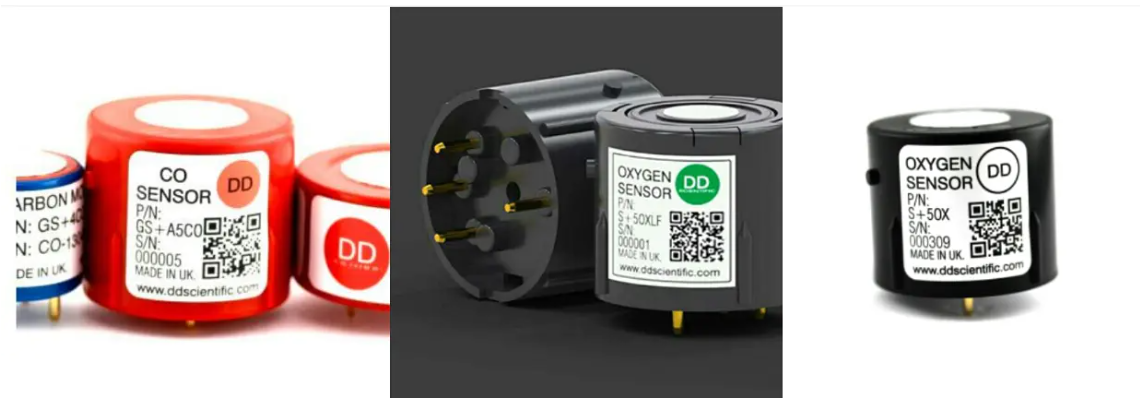
To improve the compliance of boiler air pollutant emission standards, strengthen air pollution prevention and control, and promote the improvement of ambient air quality, the current industry challenge in flue gas detection for biomass boilers lies in meeting the requirements of ultra-low measuring ranges and multi-component gas analysis. Therefore, flue gas analyzers need to detect O₂ and CO, which relies on high-performance gas sensors.
Shenzhen Yuanxin Semiconductor Co., Ltd. provides O₂, CO and other gas sensors for industrial applications, with specific products as follows: